


Kondinin Wind Project Reaches Financial Close as Shell Steps Out and Foresight Takes Full Control
Key Takeaways
- What happened: The Kondinin wind project in Western Australia has reached financial close (FID) for its 130 MW first stage, so construction can begin.
- Who is funding it: A $430 million debt package from a syndicate of mostly Australian banks, including CBA, Westpac and ANZ.
- Who is leaving: Shell has sold its stake. UK-based Foresight Group now owns 100% of the project.
- Why it matters: Kondinin is the fourth wind farm to start construction on WA’s main grid, at a time when the state needs new capacity before its last state-owned coal generators close in 2029.
- When power starts: Stage 1 is expected to supply electricity from late 2028.
What Is the Kondinin Wind Project?
The Kondinin wind project is a planned wind development in Western Australia’s Wheatbelt region. The full vision is up to 370 MW. The first stage is 130 MW and will use 21 Vestas V162-6.2 MW turbines.
The project began life with WA-based developer Lacour in 2016. It was originally designed as a hybrid of wind, solar and battery storage. In 2022 Lacour sold it to a joint venture of Shell and Foresight. Four years later, the partnership is ending, but the project itself is moving into its most important phase: building.
What Does “Financial Close” Actually Mean?
Many readers see “financial close” or “FID” in energy headlines and skip past it. It is worth understanding, because it is the point where a project stops being a plan and becomes a build.
Financial close means all the funding agreements are signed and the money is committed. Lenders are satisfied with the contracts, the revenue arrangements and the risks. Before this point, a wind farm can have approvals, a site and turbines picked out, and still not get built. After it, construction crews and turbine deliveries follow.
For Kondinin, that milestone came when Foresight announced the $430 million debt financing for Stage 1.
The Funding: Australian Banks Backing a WA Wind Project
The debt came from a syndicate that is mostly Australian banks, including Commonwealth Bank (CBA), Westpac and ANZ.
That mix says something useful. Domestic lenders remain comfortable backing utility-scale wind in Australia, even as global sentiment around renewables has become more mixed. When the country’s biggest banks commit hundreds of millions to a project, it usually means the revenue side of the deal looks solid.
Why Shell Is Leaving?
Shell has sold its stake in Kondinin. Foresight now holds full ownership of the project.
This is not an isolated decision. Shell has been stepping back from renewable investments, as have most of the other large oil companies. Oil majors moved into wind and solar with big announcements a few years ago, and many have since refocused on their core oil and gas businesses.
The important point for Kondinin is that Shell’s exit did not stop the project. The financing closed anyway. The asset simply moved to an owner whose business is renewable infrastructure.
Foresight was gracious about the change. Daniel Beaver, portfolio manager of the Foresight Australian Renewables Income Fund, thanked Shell Energy for its contribution and its partnership over the past four years. He also said the fund’s focus now turns to delivering Stage 1 and progressing the later stages of the wider Kondinin Energy Project.
Who Is Foresight?
Foresight is an investment fund listed on the London Stock Exchange. Its Australian Renewables Income Fund (ARIF) is a wholesale, unlisted unit trust set up to invest in renewable energy in Australia and New Zealand.
ARIF’s portfolio currently includes:
- Six operational wind farms
- Three operational hydro power stations
- An operational portfolio of 16 solar farms, mostly small projects under 5 MW
- Assets across both the NEM (eastern states) and the WEM (Western Australia)
- A development pipeline of 3 GW
So Foresight is not a newcomer. It already runs generating assets in both of Australia’s major electricity markets, and Kondinin adds a large new WA project to that base.
Part of a Bigger Wave: WA’s Wind Construction Boom
Kondinin is the fourth wind farm to begin construction on WA’s main grid, the South West Interconnected System (SWIS). Here is where the other projects stand:
- Waddi and Narrogin: Construction has already started.
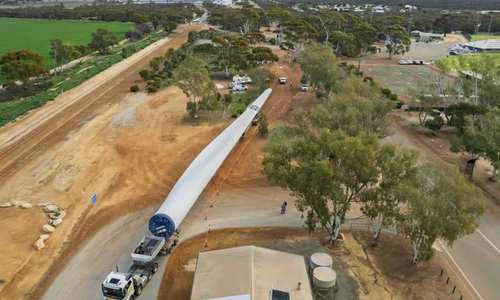
- Kings Rocks: The first turbine deliveries have been made.
- Warradarge expansion: The last turbine has been completed.
- Nullagine (Pilbara): Fortescue is about to erect the first turbine. This project is not connected to the state’s main grid.
- Parron Maam Marang: At 470 MW, this is the biggest of the group. It is expected to reach FID soon and has already announced a key construction contract.
The reason for this burst of activity is timing. The state’s last state-owned coal generators are scheduled to close in 2029. Replacement capacity has to be built and connected before then, and wind projects take years to develop, finance and construct. Kondinin’s Stage 1 is expected to begin supplying power from late 2028, which fits inside that window.
The Role of Synergy and Federal Support
Two forms of government-linked support helped get these projects financed.
Power purchase agreements with Synergy. Some of the projects, including Kondinin, Neoen Australia’s Narrogin and Atmos Renewables’ Parron Maam Marang, have secured power purchase agreements (PPAs) with the state-owned utility Synergy. A PPA gives a project a buyer for its electricity at an agreed arrangement, which is what lenders want to see. According to the source reporting, these agreements were critical to getting financing over the line.
Capacity Investment Scheme underwriting. Kondinin has also received an underwriting agreement under the federal government’s Capacity Investment Scheme. This adds a further layer of revenue certainty and supports the broader national renewable plan.
Taken together, these show how large renewable projects actually get built in Australia today. It is rarely one thing. It is a combination of a committed buyer, federal underwriting, patient bank debt and an experienced owner.
Local Benefits: Jobs and Community Fund
The project’s community package is specific:
- 145 direct jobs during construction of Stage 1.
- A community benefit fund providing $150,000 a year, indexed to CPI, for local projects. It runs for more than 25 years from the start of construction.
- Early talks with local businesses about supply and business opportunities.
- Engagement with Traditional Owners.
Beaver described Kondinin as a long-term investment in the region as well as in WA’s energy system. He credited landholders, the Shire and the local community for their support in reaching this point.
For regional communities, the details matter. A fixed annual fund that rises with inflation and lasts a quarter-century is more meaningful than a one-off payment, and early conversations with local suppliers give businesses time to prepare before construction ramps up.
Expert Analysis: What This Deal Tells Us
The following is analysis, not reported fact.
1. Owner changes do not have to stall projects. A major partner leaving a joint venture can spook lenders. Here, the financing closed alongside the exit, which suggests the project’s fundamentals, meaning its contracts, revenue support and technology, carried the deal.
2. Oil majors are leaving, but capital is not. Shell’s retreat from renewables is real, yet specialist renewable investors and Australian banks are filling the gap. The money is changing hands, not disappearing.
3. Policy support is doing heavy lifting. State PPAs and federal underwriting keep appearing in the projects that reach FID. Developers and lenders clearly value that certainty, and future project pipelines will likely depend on it continuing.
4. The 2029 coal deadline is a hard constraint. Construction lead times leave little slack. That is why so many WA wind farms are moving at once, and why any delay to one of them, such as Parron Maam Marang, deserves close watching.
5. The federal picture gets a boost. The source article notes that the wave of projects reaching financial close eases pressure on the federal government’s wider renewable plans. Each project that gets built is one less gap in the national story.
What to Watch Next?
- Parron Maam Marang reaching FID. At 470 MW, it is the largest project in the group.
- Kondinin Stage 1 construction progress through 2027 and 2028.
- Later Kondinin stages, which Foresight says it will pursue after Stage 1, up to the full 370 MW.
- Other oil companies and whether more follow Shell’s exit from renewables.
Frequently Asked Questions
What is the Kondinin wind project?
- It is a wind development in Western Australia planned at up to 370 MW. Stage 1 is 130 MW, using 21 Vestas V162-6.2 MW turbines.
Who owns the Kondinin wind project now?
- Foresight Group, through its Australian Renewables Income Fund, has full ownership after Shell sold its stake.
How much debt financing was raised?
- A $430 million debt package from a syndicate of mostly Australian banks, including CBA, Westpac and ANZ.
When will Kondinin start producing electricity?
Stage 1 is expected to begin supplying renewable electricity into the South West Interconnected System from late 2028.
How many jobs will it create?
- Stage 1 is expected to support 145 direct jobs during construction.
Why did Shell sell its stake?
- Shell sold as part of a general retreat from renewable investments, a trend shared by most of the oil industry.
How does this relate to WA’s coal closures?
- The state’s last state-owned coal generators are planned to close in 2029. Projects like Kondinin are being built to provide replacement capacity before then.
What is the Capacity Investment Scheme?
- It is a federal government program that supports new capacity investment. Kondinin has received an underwriting agreement under the scheme.
Kondinin’s financial close is a solid milestone for Western Australia’s energy transition. A big oil company is leaving, a specialist renewable investor is taking full control, Australian banks are lending $430 million, and construction is set to begin on a project that should deliver power by late 2028. With the 2029 coal closure deadline approaching, that timeline is exactly what the state needs.